
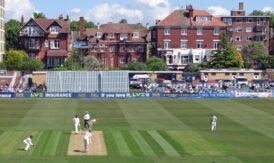

The photo shows a county match in progress at the Sussex ground of Hove.
The time is now ripe to engage with the sceptics. Not only those of the Cricket Web forum back in mid-August last year in relation to a proposal that I had posted, but also those who I label Test match “doomsters”.
There is a hiatus with England’s Test matches at present, extending from January to early-June this year, when they meet New Zealand; and not much else is happening at Test level prior to that (two Bangladesh vs Pakistan matches in early-mid May, and one Ireland vs New Zealand match in late-May).
This two-part article is produced here not to try and convince the sceptics and doomsters at great length in an earnest attempt to get them to change their (generally steadfast) positions. Rather, it is to respond to them in a spirited, and sometimes provocative, way. Yes, it is intended to make them sit up and think…hard.
A number of criticisms were levelled by participants of the Cricket Web forum last August of my proposed 100 (or 110) Overs limit for each team’s first innings in men’s Test matches.
One of these participants – Starfighter – offered the opinion about a similar rule that was applied a while ago for the English County Championship (hereafter abbreviated to CTY CHAMP) – saying, “ It was afterwards almost universally considered to be a disaster.”
This was, in effect, an invitation to examine such a claim – duly done in this Part I. That rule seems to have had a number of favourable effects, as outlined shortly.
Another participant – Swede – considered my proposal to be “A terrible solution to a problem that does not exist.” Although this person didn’t say why they consider it a terrible solution, I produce below evidence on the frequency of Test matches that are a foregone conclusion well before their ending. This is done prior to outlining what I view to be the merits of my proposal.
Other cautionary, and adverse, comments are addressed in Part II in considering the present state of Test cricket.
Nature of My Proposal: a recap
To recap on the nature of my proposal, titled Can Test Matches Get Even Better? – as published on the Cricket Web site on 13 August 2025 (1,360 words):
This was to impose a limit on the number of overs to be received by each team’s first innings in Tests, setting this maximum at either 100 or 110 overs.
Assuming both teams survive their full quota, this would typically occupy one full day’s play, plus a further 18 – or 28 – overs which would take up around 1 hour and 20 minutes – or 2 hours and 5 minutes – of playing time on day two (based on a grand average for the previous two and a half calendar years of Tests, with 13.6 overs being delivered per hour).
These maximums for overs to be received were my intuitive guesses at reasonable limits to impose, and I had them tested through an investigation of their likely impact, using match results and innings-by-innings statistics for four of the major Test playing countries. The period examined was the start of 2023 through to a cut-off at early-August 2025. The countries concerned being England, Australia, South Africa and India.
For those matches when one team used up at least 100 overs, I gave greatest attention to establishing:
- The proportion of matches won; and how many of these wins were big – ie by a margin of 100 plus runs or 6 plus wickets.
- The proportion of draws: firstly, due to a high scoring match; and, secondly, due to bad weather.
Main Findings
For cases when 100 Plus Overs were used up by one of the two teams
(comprising two-fifths of all the matches examined: giving 41 cases)
25 WINS (61% of total cases) – 20 of them being BIG (49% of all cases).
10 DRAWS – 4 due to a high scoring match, 6 due to bad weather.
Only 6 cases of Losses resulting.
It should be noted that of all the “big wins” included in this summary, only four were against “minnows” – ie against Zimbabwe (three) and Ireland (one), whilst there were none played against Afghanistan.
Of interest is that 11 of the 25 Wins occurred when the team concerned batted second – with 8 of those 11 wins being big ones. So initial use of the pitch wasn’t a dominant factor.
(There is, above, a small correction from my August 2025 article, which gave Big Wins as 19 instead of 20.)
Benefits if a 100 Overs Limit had Applied
The principal impact would have been, instead of having a high frequency of matches dominated by one team and a more or less inevitable, foregone, conclusion well before the actual end of the match, the dullness for spectators would have been much reduced. And so the overall level of enjoyment derived from watching these matches, at the grounds and on television, would have been be considerably increased.
Examining the sample taken indicates that when a first innings lasts for more than around 100 overs, the match often tends to become very one-sided – generally fairly early on – with only one of the teams then being able to produce a victory. This tendency would be alleviated.
Also, by imposing a 100 overs limit on the first innings, the perceived “threat” of the demise of Test Cricket should be reduced, as discussed in my Part II.
There are some additional beneficial effects to bear in mind:
- With five days of scheduled play, and no restriction on number of overs received, there is no pressure on the side going in to bat first to score at more than around 3.3 runs per over (being typical for the period 2022-24, other than for England) – unless the team is behind in the series. This lack of pressure could easily engender an ultra-conservative approach to batting.
- The workload and stress on fast bowlers – with long run ups and high energy expended – would be more manageable and extend their career spans.
- The cost of Test match tickets in England is currently between around 90 and 160 pounds – expensive in most people’s budget! Value for money therefore needs to be a consideration.
- Eventually, the sale value of broadcasting rights may be dented if overs received is left unrestricted. Since this is what funds professional cricket the world over, this also needs considering.
Most of the game’s rules and regulations exist to impose penalties for certain actions. In contrast, this proposed stipulation would be there to avoid certain situations occurring (as outlined) for the benefit of spectators, while also contributing to the health of this “pinnacle” format of the game.
“““““““““““““““““““““““““““““““““““`
The initial criticism – by Starfighter, noted above – motivated a good deal of research into the 200 over limit rule placed on the combined first innings of CTY CHAMP matches of the 1970s, and also some other experiments made during the 1960s through to the late-1980s. This investigation was largely conducted by Bruce Kempen, a London-based researcher having access to all relevant back issues of The Cricketer magazine as well as editions of the annual Wisden Cricketers’ Almanack – these, seemingly, being the two best sources.
Overall Success of the Similar Rule Applied in CTY CHAMP Matches
From start of the 1974 English season, through to end of the 1980 season, there was a limit placed of 200 overs for the teams’ combined first innings in the county championship matches. The team batting first was restricted to a maximum of 100 overs, and any overs of the quota not used up were then added to the other team’s first innings quota, which gave an incentive for bowlers to search for wickets. This regulation was “received well enough by the players.”
In regard to its main objectives, this rule can be counted as a success. These objectives being to:
- encourage attacking play and lower the frequency of draws, and
- reduce the all too common practice of collusion between the captains, using declarations to set up a last day run chase – in an attempt to obtain a positive result, following an academic couple of days solely in search of bonus points.
It was also thought by EW Swanton, supported by some other commentators, that it would “bring back spin bowling with a stretching of the second innings.”
Collusion between captains became less common as a result of imposing this rule – “more genuine, uncontrived, results” – and it did cut down materially (rather than just trivially) on the high proportion of draws. In a review article of December 1983 by the Hampshire captain, Nick Pocock, he noted there had been a return to a good deal of collusion between captains following the elimination of the 100 Overs regulation – again, so as to try to get a positive result in the three-day matches.
The stats on the proportion of drawn county matches show a material reduction, of 11% in proportional terms, for the seven seasons when the overs limitation was being applied:
- Prior to the rule, from 1967-73: 52.3% drawn matches
- During the rule, 7 seasons from 1974-80: 46.9% of draws
- Afterwards, from 1981-87: 53.0% of draws
(ie before 4-day matches were phased in during 1988-93)
However, inconclusive outcomes were endemic with two innings a side 3-day matches, given the shortage of potential playing time and the inroads made by typical English spring/summer weather.
At their meeting in February 1981, the Test and County Cricket Board (TCCB) voted to dispense with the first innings limitation for county matches as from the start of that season.
Through his published lectures at Cambridge University in 1961, Edward Hallett Carr has taught us that history inevitably involves interpretation, not just straightforward use of an assembly of what are deemed to be factual materials.
To quote him:
To praise a historian for his accuracy is like praising an architect for using well-seasoned timber in his building. It is a necessary condition of his work, but not his essential function…Of course, facts and documents are needed by the historian. But they do not, by themselves, constitute history. History means interpretation.
E. H. Carr, What is History? Penguin Books,Second edition 1987 (pages 10-11).
My interpretation of Bruce Kempen’s research (as set out in Appendix I) is that this restriction of overs for first innings was dropped not because of the fact that some county representatives considered it discouraged the fielding side from attacking in the first innings – which is itself rather surprising as Tests sides are often dismissed for less than 100 overs in their first innings.
By my count, during the period of this limitation on overs delivered, England succumbed in Tests in their first innings for under 100 overs on 31 occasions during the 72 matches, a little more than half of which were of under 80 overs duration (17 cases).
Rather, it was dropped for the reason that the Board itself published about their decision: “We have made the change in the hope that potential Test cricketers can play in the best possible conditions.”
This explanation links tothe point that a number of county representatives thought this restriction on number of overs often had an adverse effect on middle order batsmen, inducing them to attack before getting settled-in, and that it worked against spin bowlers (in the first innings). It was the insidious desire to treat the CTY CHAMP as a preparation for potential Test players that seems to have been the fundamental reason for the abolition of this regulation.
It can be argued that if the CTY CHAMP were to be treated as a competition for its own sake, with players emerging as Test match material incidentally as it were, then a limit of 100 overs was not stringent, or severe, enough – especially for the aim of lowering the incidence of draws. Indeed, it had a tougher forebear, as discussed shortly.
Four-day matches were introduced, along with “full covering” of pitches (ie during any gaps in play due to bad weather as well as overnight) primarily to provide a better format for grooming potential players for the national side. Using the County Championship for this purpose was a strong under-current in the TCCB’s thinking during the 1970s right through to the ’90s and has persisted under the ECB (replacing the TCCB at the start of 1997).
In March 1993, Simon Heffer (deputy editor of the UK’s Spectator magazine) observed:
“In recent years, cricket authorities have done nothing to promote the county game. It has now been reduced to a training camp for the national side. The principal reason for extending county matches to four days, it’s alleged, is to better prepare them for their prime purpose in life – playing for England. It will ensure that that the financial losses experienced by county clubs are even larger – an absurdity!”
This mentality of using county matches for preparing players for Test cricket also underlay the TCCB’s instructions to the counties to prepare better pitches for batting on – dry, hard, fast and true (more reliable) ones. There were repeated exhortations made to the counties to prepare such pitches, with them expressing commitments which, usually, didn’t amount to much in practice.
In parallel, the TCCB took a decision to bring in full covering of pitches (as noted above) – which had been mandatory practice for all Tests in England since 1979, after a staged introduction. It was also hoped that the extended scheduled of play in county matches – the extra day – would encourage spin bowlers, at least on the last day with an expected wearing and turning pitch.
In the June 1988 issue of The Cricketer magazine, Christopher Martin-Jenkins wrote:
“On the experiment with four-day matches: the hope {realised} is that it will encourage spinners by giving them some wearing pitches to exploit towards the end of the games.”
| England have certainly been acceptable in the SLA department since four-day county matches came in. With Phil Tufnell (1990-2001) – brilliant in patches – plus Ashley Giles (2000-2006, following one match in 1998), though expensive overall; and Monty Panesar (2006-13). These three followed on from a tradition exemplified by Derek Underwood (1966-82) and Phil Edmonds (1975-87).
Although high quality off-spinners have been few and far between for England – the deeds of Graeme Swann (2008-13) being a notable exception. David Acfield, who played first-class matches for fully two decades (1966-86) was, for some reason unknown to me, overlooked by the Test selectors. Maybe if Acfield had worked more on his batting (he averaged 8.2) and had forgone fencing as a sport….. |
| As for (right arm) leg spinners, there’s been a dearth of them for England’s Test matches. One of the few who has been effective at that level (this being prior to 4-day county matches) was Tommy Greenhough of Lancashire, who also employed a googly. He bowled in eight Test innings, during 1959-60, all being at home – against India (six innings) and against South Africa (two innings). He had no poor matches and snared his 16 victims at a very commendable 22.3 runs apiece – doing so with surprising economy, conceding only 1.9 runs per over. However, as Martin Williamson has pointed out, defensive finger spinners were the vouge for England in those times and Greenhough was considered something of a luxury, given he contributed little with the bat.
Off-break staples in Greenhough’s playing days were: Jim Laker (Tests from 1948-59) with 193 victims – 2.2 per innings – at a misery cost of 21.2 runs apiece; Roy Tattersall (16 Tests from 1951-54); Fred Titmus (Tests from 1955-75) with 153 wickets at 1.7 per innings, captured at 32.2 runs apiece; Ray Illingworth (Tests from 1958-73), 122 wickets at 1.2 per innings, costing 31.2 runs apiece; and David Allen (Tests from 1960-66), also taking 122 wickets, doing so at 1.9 per innings at a cost of 30.9 runs apiece. |
During this period of the mid-1960s through to the late-1980s, various levels of fines were tried in a generally unsuccessful endeavour to raise the sluggish over rate. And the frequency of drawn CTY CHAMP four-day matches up to the end of the 2024 season, although somewhat lower than for the previous three-dayers, averaged an unhealthy 39%.
At least one prominent commentator – former Test player, Derek Pringle – has recently called for a reversion to three-day county matches and uncovered pitches, and to forget about the long-held aim of making the championship basically a means of preparing Test players. This is, anyway, now a fraught aim with the advent of “central contracts” from season 2000 and with the England selectors paying little attention to how players are performing in county matches. Make the county matches interesting and enjoyable for their own sake, Pringle urges. (The Case for Three-Day Cricket: article appearing in The Cricketer magazine, Summer 2025.)
A Draconian Forebear
The “200 overs for both sides combined” regulation had a draconian forebear. In 1966, a restriction of a maximum of 65 overs for CTY CHAMP matches was imposed on each team’s first innings. This followed a decision taken that March by the Advisory County Cricket Committee (based on a recommendation of a special sub-committee).
Billed as an “experiment”, it wasn’t applied right across the board, but rather to each county’s initial 12 matches against opposition they played twice – which covered just over two-fifths of all the Championship matches (102 of 238 matches). There was no limit on the number of overs that a given bowler may deliver in these innings.
The underlying reasons given by the Committee for imposing this rule were to:
(a) Give spectators more entertainment on the first day, as they would be able to see both sides bat.
Noting: “The drop in attendances demands a serious attempt to find a remedy.” The aggregate figure for 1965 (excluding tourist matches) was 659,560, this being the lowest of any year since records had been kept. The average gate for 1963-65 was 25% below that for 1960-62 which, in turn, was 17% down on 1957-59.
(b) Encourage the use of spin bowling in the second innings, as these innings will typically be longer.
(c) Encourage the preparation of good pitches, with the second innings usually being longer than the first – being pointed out as redundant as every county had already pledged to provide such pitches.
The low standard of pitch preparation was noted as a concern. “Pitches need to be brought back to a high standard to produce a similar number of top-class players as there were before WW2.
Former Test player Tony Lewis considered the move was an attempt to get out of the rut. “It has gone to the heart of the matter and I anticipate the best results.” He suggested that, on a real turner of a pitch, one might see an off-spinner with 7, or even 8, fielders on the leg side. He expected the 65 overs limit to benefit batsmen with the widest range of strokes and who perform well under pressure.
The criticisms of county cricket, at that time, centred on:
- The first innings of both teams had become a prolonged manoeuvre with resultant dull play on the initial two days.
- Lack of spectator appeal: attendances had continually declined over the years.
- Substantial financial losses were being incurred annually by the Counties.
Doug Insole, then Chairman of Test Selectors, noted: “This experiment has long been recommended by some counties, and it is probably right that it should be put to the test.”
There were a number of sceptics, and some were downright opposed to it – the most trenchant critic in advance of its implementation being Jim Swanton.
Come mid-season, Tony Lewis reported: “The anti-65 Over regulation voices are increasing and booming. Why should the weaker side be kept in the game by this artificial restriction?”
He continued: “It has produced a weird fashion of slogging…a series of undignified slogs during the last 10-15 overs; and also produced a climax on the first day, rather than late in the game when victory is to be gained or denied.”
After-the-event statistics showed:
- Nearly two-thirds of the 101 matches under the 65 Over rule produced a definite result – that is, 61 of them, or 60.4% – with a further 40 matches being drawn (ignoring one abandoned match without any play taking place).
- This compared with 54.6% for the other 130 matches played up to end of August that year without the restriction. The proportions for the previous three years being: 1965: 51.7%; 1964: 58.0%; and 1963: 51.7%.
- The average for the three years, 1963-65, being 53.8%, which is 11% lower than for the 65 Over rule that applied to matches in 1966. So the rule produced a substantial increase in the frequency of positive outcomes.
Also of interest:
- For nearly half of the matches under this rule, 46 of the 101, definite results occurred without a third-innings declaration.
- Little or no advantage was gained by the side having first use of the pitch.
- Only once did a side get to 300 on first innings, and only 11 batsmen scored a century in these regulated matches (a few of the batsmen doing so multiple times, producing 15 centuries in total).
Wisden highlighted:
“Opposition to the 65 Over experiment was mainly due to the problem it set the middle-order batsmen. They often couldn’t settle down to build an innings and had to push the score along before being ready to do so.”
Also: “It favoured the weaker bowling sides, and a premium was put on a negative attack and supporting field placings to keep the score down, rather than endeavouring to dismiss the opposition.”
At the Advisory County Cricket Committee meeting in November that year (1966), the decision was taken to discontinue the 65 Over first innings experiment, reflecting the adverse comments already referred to.
Nonetheless, more than two and a half decades later, in 1991 Ted Lester, the former Yorkshire County batsman and subsequent scorer, suggested a limit on first innings in the CTY CHAMP as low as 60 overs.
(A forceful and entertaining right hand batsman, Ted Lester played 347 innings in first-class matches between 1945 and 1956, when age 22 to 33 – averaging 34.2 per completed innings with 25 centuries. Afterwards scoring for the county through to 1992.)
Pursuing the theme of wanting to end the contrived county match finishes, Lester said:
- Contrived finishes have done nothing to arrest either the decline in county membership levels or the reduction in paying spectators at the grounds.
- The present Championship matches usually comprise two days playing for bonus points, with the third day producing a brand of cricket more akin to the one-day game.
- He advocated a limit of only 60 overs for each team’s first innings, along with extended hours of play on the first day, so as to complete both first innings (with bonus points to be awarded to the team ahead on first innings). Saying: One could then proceed normally on the second and third days without recourse to any form of contrivance.
- He also proposed to restrict the number of batsmen participating in the first innings, suggesting that only 6 be allowed; hence, the innings would be closed after the fall of the fifth wicket. This, he thought, would encourage bowlers to attack, as well as reduce the amount of time consumed before the second innings got underway.
- Lester also wanted to eliminate the traditional coin toss before play. Choice of whether to bat or bowl first would be the prerogative of the visiting team – to prevent pitch preparation to suit the strengths of the home team. And he would give the team leading on first innings the choice of batting or bowling next.
To Conclude on the Two Limits Placed on Number of Overs in CTY CHAMP Matches
Both the 1966 and 1974-81 limits placed on first innings in CTY CHAMP matches had beneficial effects and well as some drawbacks. It demonstrated that trade-offs are, inevitably, involved in such attempted reforms, and reinforce the point that no measures aimed at injecting more life into these county matches were going to be a perfect solution.
The search for an ideal solution has to be viewed in relation to the stated aims. This was illustrated in November 1966 when the Advisory County Cricket Committee – in considering possible reforms for county cricket – specified the principal objectives to be as follows:
(a) To produce the highest possible standard of play.
(b) To provide a form of entertainment that will appeal to spectators and be available when the majority are available to attend.
(c) To improve the financial position of all counties, and particularly those that are currently in difficulties.
Subsequently…to Most Recent Times
The English County Championship subsequently evolved to be in a relatively good place, especially in season 2019 – just before Covid struck – producing many interesting and highly enjoyable matches. Indeed, much “thrilling excitement” was to be had. But the Championship befell considerably worse than Covid in 2021 with the introduction of The Hundred (domestic) competition, and it has been in a veritable pickle ever since!
| Author’s Note
To save readers the laborious task of – potentially – downloading and printing out the text of this piece, and my following piece which is to appear next week, I shall be happy to arrange for a printed (Word document) version of these to be sent out to you by postal service. I can be contacted at this email address: |
Appendix I: Extracts from The Cricketer magazine for 1966 and 1967,
and Wisden CA 1967 Edition
1966 Issues of The Cricketer Magazine
Decision taken by the Advisory County Cricket Committee (based on a recommendation of a special sub-committee) in March 1966 to introduce a regulation that limits first innings to a maximum of 65 overs. To be applied to each county’s initial 12 matches against opposition they play twice – covering around two-fifths of the Championship matches (102 of 238 matches). There will be no limit on the number of overs that a given bowler may deliver in these innings. It was billed as an “experiment”.
Three reasons given by the Committee for its adoption:
(a) To give spectators more entertainment on the first day; able to see both sides bat.
Also noted that the drop in attendances demands a serious attempt to find a remedy. Aggregate figure for 1965 (excluding tourist matches) was 659,560, the lowest of any year since records kept. The average gate for 1963-65 was 25% below that for 1960-62 which was itself 17% down on 1957-59.
(b) It might encourage deployment of spin bowling in the second innings – as these will, typically, be longer.
(c) To encourage the preparation of sound pitches, with the second innings usually lasting longer than the first – though perhaps a redundant reason as every county has already pledged to provide them.
The low standard of pitch preparation noted as a concern. Pitches need to be brought back to a high standard to produce a similar number of top-class players as there were before WW2.
- The anonymous columnist “Felix” thought the proposal likely to make the fielding side try to deny runs as a priority, rather than to take wickets.
- EW Swanton aghast at this “most drastic and deplorable reform”. It is likely to mean that neither side gets well ahead on first innings, supposedly to give the crowd an exciting finale.
- Also:
- Each county committee must instruct their teams to bowl, on average, 20 overs per hour – no penalties for failing are specified, only the reasons to be noted.
- Shining of the ball is abolished.
- De-restriction of the number of leg-side fielders.
Tony Lewis: Cricketer’s Notes
- Defends the Advisory Committee decision on 65 overs as an attempt to get out of the rut – the C’ee being “made up of eminent cricketers who are deeply involved with the game” –. “It has gone to the heart of the matter and I anticipate the best results.”
- “On a real turner of a pitch, might see an off-spinner with 7 or even 8 fielders on the leg side.”
- Lewis expected the rule to benefit batsmen with the widest range of strokes and who perform well under pressure.
Cricketer Magazine Opinion Poll of readers
- Only 15% of respondents in favour of the 65 over rule – this being before it got to be tried out.
Analysis column by Doug Insole, then Chairman of Selectors
- He says, “This experiment has long been recommended by some counties, and probably right it should be put to the test.”
Columnist “Felix”
-
- In May and June, the state of pitches generally very poor. England batsmen say openly that the only time they get a good pitch to bat on is a Test match.
- Futile to expect a strongly equipped England XI until county cricket is made virile and its more obvious limitations removed. The 65 over experiment is the last straw – cutting down on batsmen’s opportunities to play a substantial/long innings.
Tony Lewis: Cricketer’s Notes (mid-season)
- The anti-65 Over regulation voices are increasing and booming.
- Why should the weaker side be kept in the game by this artificial restriction?
- And it’s produced “a weird fashion of slogging…a series of undignified slogs during the last 10-15 overs.”
- Also, it produces a climax on the first day, rather than late in the game, when victory is gained or denied.
Columnist “Felix”
As summer nears its end, asks: which way forward?
- 65 over limit has reinforced defensive out-cricket.
- County play on Sundays has proved popular and profitable.
- There are calls for a Ch’ship based on 16 matches per county.
“The 65 -over experiment – a few figures”
- Nearly two-thirds of the 102 matches under the 65 over rule produced a definite result: 61 of them, with 40 drawn (and 1 abandoned with no play taking place) – ie 60.4% (ignoring the abandoned match).
- Compared with 54.6% for the other 130 matches played up to end August: for 1965- 51.7%; for 1964 – 58.0%; for 1963 – 51.7%.
- The four year average being 54.0% of definite result matches, which is 11% lower than for the 65 over rule matches of 1966.
Also:
- 46 of the definite results occurred without a third-innings declaration.
- Little or no advantage has been gained by the side having first use of the pitch.
- Only once did a side get to 300 runs on first innings, and only 11 batsmen scored a century under the 65 Over restriction (a few of them doing so multiple times, producing 15 centuries in all).
Tony Lewis: Cricketer’s Notes (end of season)
- The existing structure of English county cricket is no longer financially viable.
- The shape of the future might include four-day matches with play during the week-end. Then sides will be trying to bowl each other out and not contain – “though it would certainly produce very slow batting – especially on the existing pitches.” The paying public have taken to the one-day Gillette Cup competition.
Nettles Ungrasped, by John Woodcock
- The Advisory County Cricket Committee’s autumn (November) meeting: only the abolition of the 65 over experiment brought a cheer.
- A proposal to limit bowlers’ run-ups to 20 yards was not endorsed.
- In 1967, for a second consecutive season, there will be no polishing of the ball in county matches.
1967 Issues of The Cricketer Magazine
Spectators at the County Ch’ship grounds and membership numbers:
- Affluence is the most important differentiating factor between the individual counties. The South East and Midlands are the most prosperous, where people are turning away from watching county cricket to “more sophisticated” leisure pursuits, such as sailing.
- Average daily attendance at the matches per head of resident population of a county in 1966 varied between 1 in 488 to 1 in 2,124. Mostly around 1 in 500 to 800 level.
Pitches have been condemned by the players (in a poll). They are unanimous that hard, fast and true pitches would improve the standard of play.
Wisden – 1967 Edition
- MCC is given the authority to ban grounds reported as being unfit for first-class matches.
- For the past 20 years, continual changes made to many regulations of county game.
- Opposition to the 65 over experiment mainly been due to the problem it set the middle-order batsmen – often couldn’t settle down to build an innings and had to push the score along before being ready.
- Also: it favoured the weaker bowling sides, and a premium was put on a negative attack and supporting field placings to keep the score down, rather than endeavouring to dismiss the opposition.
- Attendances are in long-run decline: 1950 close on 2.0 mill paid to watch the Ch’ship matches; in 1966 only some 513,600 did so. The fastest rate of decline has been “in recent years…alongside an abrupt halt in the overall increase in membership numbers: 1966 was down 5% on 1964 (135,045 vs 141,707).
- The 65 Over experiment arose from the Advisory Committee meeting in March 1966. Among the criticisms of county cricket at that time were:
- The first innings have become a prolonged manoeuvre with resultant dull play on the initial two days.
- Lack of spectator appeal: attendances have continually declined over the years.
- Covering of pitches in County Ch’ship matches is to be brought into line with present Test match practice in England – ie complete covering night before a match, after play for day, and during the playing hours when play is halted due to rain or bad light or when rain occurs during lunch or tea breaks.
- Substantial financial losses are being incurred annually by the Counties.
The Advisory County Cricket Committee meeting in November 1966:
-
- Decision taken to discontinue the 65 Over first innings experiment, for three reasons:
(i) It encouraged negative fielding and bowling tactics.
(ii) It adversely affected middle-order batsmen.
(iii) It discouraged spin bowling.
- Due to some support by counties for reverting to uncovered pitches, it was decided that for 1967 the counties can either “fully” cover – as for Test matches – including each night and at week-ends, or not cover at all.
- Principal objectives in considering possible reforms for county cricket going forward:
- Decision taken to discontinue the 65 Over first innings experiment, for three reasons:
(a) To produce the highest possible standard of play.
(b) To provide a form of entertainment that will appeal to spectators and be available when the majority are available to attend.
(c) To improve the financial position of all counties, and particularly those that are currently in difficulties.
Appendix II: Extracts from The Cricketer magazine and Wisden CA
on the English County Championship: 1974-93
Key Milestones
- A limit of 200 overs applied to the combined first innings, so if team batting first was dismissed for less than 100 overs, the balance overs was then added to the other team’s quota. The restriction was applied from start of 1974 season through to end of season 1981.
- “Full covering” of pitches – ie throughout any gaps in play and overnight – came in for the 1981 season (as already done for Tests) and has remained in force ever since.
- Four-day matches were phased in progressively during 1988-92, with comprehensive application thereafter, in lieu of three-day matches.
Impact of the regulation on the proportion of draws. Reducing this proportion being the prime motivation.
- The previous 8 seasons together with the subsequent 6 seasons (before the initial introduction of some 4-day matches) resulted in 52.1% of drawn matches – compared with 46.6% drawn during the Regulation’s 8 years in force.
- So draws were down by 10.6%: a material reduction.
The Detail:
- Before, 1966-73: Draws 50.5%
- During the 200 Overs for Combined First Innings Regulation from 1974-81:
Draws 46.6% - Afterwards, 1982-87: Draws 54.3%
NOTES on the EXTRACTS – Chronologically Ordered
CM, CR and Cric all denote The Cricketer Magazine; Wis the annual Wisden Cricketers’ Almanack – published in the year following the season under review.
CM – Feb ’74
EW Swanton article
- For him, the new 100 over regulation “goes against the grain, though it has been received well enough by the players”.
- The regulation was instituted to encourage definite results and to impress the need for – attacking play. And it should bring back spin with a stretching of the second innings.
- There’s been a decline in the quantity and quality of slow bowling in recent years (in the County Ch’ship).
- Swanton pleased that match length not been increased to 4 days as some people want. He fears it would signal the way for slower play all round and wearisome tactics of attrition.
CM – Oct ’74
EW Swanton article
- Has the initial season of the 100 overs limit justified its introduction? Been an increase of 6 finishes: 91 in 1974 vs 85 the previous season, from 170 matches played – a “slight” improvement, though the 91 would have been nearer 100 but for the soggy conditions towards the end of the 1974 season.
- In addition, bringing forward the second innings has meant more genuine, uncontrived, results.
- The new regulation merits another year or two trial – no method is perfect and constant tinkering confuses and irritates people.
CM – June ’75
Gordon Ross article
- How to eliminate defensive play that is threatening the 3-day game?
- Precarious position of the game’s economic (financial) future – a continuing theme since 1914.
- Amalgamations between some county sides and also extinctions are mooted by some people in the know.
y – CM – Nov ’75
The Decline of Spin Bowling – Article by England and Surrey Off Spinner, Pat Pocock (25 Tests during 1968-85)
- He says: the gradual decline been largely due to improved batting techniques during the last 30 years, better at hitting across the line (especially sweeping, lapping and slogging) and becoming increasingly aggressive in their shot-making. During Pocock’s career to then, 70-75 runs an hour as a reasonable declaration target has become more than 100 an hour.
- As a result, the approach taken by spinners has become more defensive.
- Limited overs comp in England began with the Gillette Cup in 1963: 65 overs an innings soon giving way to 60 overs. In 1969, 40 over comp introduced. This lies behind teams’ improved run-chasing ability.
y – Wis – 1976 (1)
Notes by the Editor
- Present 100 overs limitation and method of awarding bonus points are unsatisfactory.
NB – The hectic chase for runs as the day progresses means bowlers obtain undeserved wickets and this isn’t conducive to developing batsmen or bowlers into Test material.
- There’s pressure for 24 matches for each county – Editor hopes without any restriction on length of innings and no bonus points at all – ie “proper first-class cricket.”
y – Wis – 1981 (2)
Re TCCB Spring 1980 Meeting
- TCCB NARROWLY rejected an all-or-nothing package of proposed changes by its cricket sub-committee (chaired by Peter May) for the County Ch’ship: elimination of the 100 overs limit, total covering of pitches and an increase in win points from 12 to 16.
- NB: the aim of this package being to give encouragement to young batsmen and bring about more positive playing strategies by captains.
y – Wis – 1981 (3)
Re TCCB Winter (Dec) 1980 Meeting: decisions taken – all carried by a substantial majority of the full committee.
- Full covering of pitches in all Ch’ship matches.
- Abolition of the 100 overs first innings limitation, from 1981 onwards.
- A new ball to be available after 85 overs.
- To compensate spin bowlers for being deprived of drying pitches, groundsmen on all first-class grounds are being asked to prepare dry pitches, more readily responsive to spin bowling.
- Bonus points will continue to be available for the first 100 overs of each side’s innings.
y – CM – Feb ’81 (a)
Changes to Regulations
- The 100 overs first innings limitation in County Ch’ship matches is to be scrapped.
- New ball can be taken after 85 overs instead of 100 overs.
- Full covering of pitches to come from 1981 season (as already done in Tests).
y – CM – Feb ’81 (b)
Comments on changes to the Ch’ship competition
Article by Peter Lush, spokesman for the TCCB
- The 100 overs limit abolition likely to receive general approval.
- Some County representatives considered it discouraged the fielding side from attacking and trying to take wickets. Also thought it often had an adverse effect on middle order batsmen, inducing them to attack before getting settled-in, and that is worked against spin bowlers in the first innings.
- “The Board say they have made the change in the hope that potential Test cricketers can play in the best possible conditions.”
- Surrey County CC are expected to recommend the Ch’ship be reduced to 16 matches – played over four days (in mid-week).
y – Wis – 1982 (1)
Re TCCB Winter (Dec) 1981 Meeting
- TCCB sternly reminded the first-class counties of their collective responsibility to try to prepare “dry, hard, fast and true pitches at all times…certain counties were setting out to produce pitches to suit their own bowlers.”
- In 1981 season, too many cases of captains’ and umpires’ reports referring to this “totally unacceptable” practice – one which the counties undertook unanimously to eliminate. If it continues, time might come for severe financial penalties to be imposed and/or visiting captains given the choice of innings.
- The decision taken to delay of a new ball until 100 rather than 85 made in the hope it may help to restore the balance of the game by promoting spin bowling.
- NB: As in other years, the suggestion that the Ch’ship be restructured to comprise 16 four-day matches was discussed inconclusively.
y – CM – Feb ’82 (a) and (b)
Editorial by Christopher Martin-Jenkins
- Three ways of increasing over rates to “acceptable” levels:
- Fining – which has proved only partially successful – TCCB been forced to raise level of fines following another drop on over rate last season.
- One alternative is applying a minimum of 100 overs per six hour day – as proposed by the TCCB for Tests.
- Another is suggestion by former Glamorgan captain CTM Pugh: for every over fewer than 20 per hour, the batting side should be awarded four extra runs. For modern times, water this down to, say, 3 extra runs for any overs less than 19 per hour – assuming the extra runs be awarded at the end of a team’s innings, rather than at the end of each hour or each session of play – allowing for artificial hold-ups, such as dog or streaker on the field of play, people in front of sight-screens (ie a backward look re average overs that have been delivered per hour).
- Batsmen might become deliberately dilatory – so a role for the umpires to check this or award penalties.
- Pugh’s suggestion should encourage more use of spinners. And this is reinforced by the TCCB’s recent decision to withhold the new ball in Ch’ship matches until 100 overs have been delivered, together with larger fines for slow over rates, n instruction for counties to prepare hard, fast and true pitches.
CR – Dec 1983 (1)
David Rayvern Allen article
- Problems with the 3-day game and financial pressures:
- Declining number of spectators at the grounds, even for a recent crucial (c/ship) match at Lord’s.
- There’s “public indifference.”
- The Ch’ship needs radical reform: bankruptcy of several counties is virtually certain within the next few years unless something (radical) is done.
- The competition format is patently out of date and in need of revision.
- There are poor prospects for finding a replacement for Schweppes as a sponsor.
- Allen wants availability of a fourth day in which to obtain a definite result. And would increase chances of batsmen being able to concentrate on building an innings – having an eye on strengthening England in Tests.
- A two tier (divisions) suggestion by Ray Illingworth, with promotion and relegation to make more fixtures towards end of the season significant.
CR – Dec ’83 (2)
Article by Nick Pocock (Hants Captain)
- The 3-day game has been weakened, by an over-crowded schedule and an unbalanced program (previous season County Ch’ship matches increased to 24):
- Top players frequently rested, for one-dayers, giving far greater financial rewards (eg – Hants came 3rd on Ch’ship ladder last season, but players received six times as much for appearing in their one-day series of matches).
- So might not find a replacement sponsor for Schweppes.
- Been a return to a good deal of collusion between captains following the elimination of the 100 Overs regulation, so as to get a positive result in the three-day game – though some captains are still aiming for victory from a position of achieved strength.
- “If more were prepared to collude and resurrect a dying match then the slow death of the three-day game could be halted.”
y – Wis – 1985: Notes by the Editor
An Unpopular Experiment
- The introduction of a minimum of 117 overs per day – 18 per hour of play – failed to get the wholehearted co-operation from the players that was needed. And the TCCB, in its Winter 1984 meeting decided to reduce this to 112 overs per day, coupled to a scale of fines.
- “Unfortunately, the typical English bowler is a medium pacer off a long run – frankly, a trundler.” It was sometimes past 8-00 pm before the 117 overs were completed and many spectators had gone home for supper, and the light became a problem when the days drew in.
The Four-Day Lobby
- Four-day matches favoured by some as better preparation for five-day Test matches. But it would be unpopular with county members and might well lead to slow play.
y – Wis – 1985 (1)
Re TCCB Winter (Dec) 1984 Meeting
- Decided to reduce the 117 overs per day to 112 as the 1984 experiment had led to a slower over rate and longer days which had been unpopular with players and umpires. Though counties failing to bowl their overs at a min of 18.5 per hour will be fined at the following rates…
y – Wis – 1987 (1)
Re Changes for 1988 Season
- Palmer Report – Recommendations: 16 three-day and 8 four-day Cty Ch’ship matches.
- Decision taken – each county to play six four-day matches.
- Editor welcomes the four-dayers if going to give young batsmen the opportunity to develop an innings properly, instead of being forced into a one-day style of cricket in pursuit of bonus points.
y – Wis – 1987 (2 & 3)
TCCB Winter meeting
- Decision taken: for first time, (six) four-day matches to be played by each county in the Ch’ship for 1988.
- The counties voted in favour of this by 15 votes to two.
y – Wis – 1988
- Actions fall flat to encourage spinners and make batsmen improve their techniques in difficult conditions.
- Uncovered pitches during the hours of play experiment applied for the 1987 season, but insufficient rain fell to aid the spinners and green pitches meant spinners rarely got fully to their work.
- Reversion to covered pitches for 1988.
Mixed Financial Positions of the Counties
- At least 5 counties have declared a loss.
Cric – June ’88
Article by Christopher Martin-Jenkins
Theme: Welcome to Four Days…with some reservations
- “On the experiment with four-day matches: the hope is that it will encourage spinners, by giving them some wearing pitches to exploit towards the end of the games.”
- “There isn’t much logic – if we are hoping to give our county players the best possible preparation for Test cricket – in retaining the batting bonus points for the first 100 overs of the first innings. How is an aspiring England number 5 going to react when coming in at 220 for three after 95 overs? Go for the extra bonus point in the interests of his team or try to lay the foundations of a big innings in the interests of his own future?”
- Suggests the four batting bonus points be available for the first 150 overs of the first innings instead.
- “Generally, however, the start to four-day cricket was auspicious.”
y – Wis – 1991 (1)
TCCB Spring mtg 1990
- Debate on the speed of transition to 4-dayers.
- Decision for three more seasons to have 16 three-day and 6 four-dayers in the Ch’ship.
- Hopes for it improving the standard of play at the top level (BK: alluding to Test play presumably).
y – Wis – 1991 (2)
TCCB Emergency Meeting in late-May 1990
- Proposal to raise the number of four-dayers to eight (from six) defeated as didn’t get a majority. The voting was split: 9-9.
CR – Oct ’91
Article by Ted Lester – former Yorkshire batsman and county scorer.
Theme: Wanting to end the contrived county match finishes
- Contrived finishes have done nothing to arrest either the decline in county membership levels or the reduction in paying spectators at the grounds.
- The present Ch’ship matches usually comprise two days playing for bonus points with the third day producing a brand of cricket more akin to the one-day game.
- Lester advocates a limit of only 60 overs for both teams’ first innings – with extended hours of play on the first day so as to complete both first innings (and bonus points awarded to the team ahead on first innings).
- Could then proceed normally on the second and third days without recourse to any form of contrivance.
- Also proposes to restrict the number of batsmen participating in the first innings, suggesting only 6 be allowed – so the innings be closed after the fall of the fifth wicket. Would encourage bowlers to attack as well as reducing the amount of time consumed before the second innings get underway.
- He’d also give the team leading on first innings the choice of batting or bowling next.
- All this being designed to reduce the frequency of drawn matches.
- He would also eliminate the traditional coin toss before play begins. Choice of whether to bat or bowl first would be the prerogative of the visiting team – to prevent pitch preparation to suit the strengths of the home team.
CR – Dec ’91
Article by former England player, Barry Wood
- Wood wants a fairer and more balanced fixture format – were then a min of 21 one-dayers and 22 Ch’ship matches.
- He has a preference for moving to four-day games. These were well in transition to replace the three-dayers by this time (1988-92)
- His reasons include:
- To relate more closely to Test cricket
- Encourage more spin bowling
- Fewer innings for batsmen – making them less complacent and keener for success
- Create more imaginative captaincy
- Adding: on so many occasions the initial two days are academic and on the third day a predictable declaration and run chase. Rarely are sides bowled out twice, and if they are it is on a “minefield”.
y – Wis – 1992 (1)
TCCB Spring Meeting, March 1991
- The Board stressed it didn’t want a return to green, over-grassed pitches.
y – Wis – 1992 (2)
TCCB Summer Meeting in 1991
- Working Party (chaired by M. P. Murray of Míddlesex) set up to investigate the state of the domestic first-class game.
Cric – Nov ’92
EW Swanton’s Watching Brief
- “The TCCB have abandoned three-day cricket against the wishes of a vast majority of county members and paying public.”
y – Wis – 1993 (1)
Notes by the Editor
- The TCCB has ground down the opposition to four-dayers, doing so by “cunning” means. All county matches to be four-dayers in the coming – 1993 – season. Said to be much disliked by those who go and watch county matches.
- Cunning because the Board has, since 1989, forced the counties to play the three-day matches on pitches that suit a four of five day game…“making the three-day game seem ridiculous”.
y – Wis – 1993 (2 & 3)
The Decline and fall of Three-Day Cricket: article by John Thicknesse
- The three-day game has been dying, slowly, since the Winter 1980 meeting of the TCCB, with a move to full covering of pitches – ie protection during breaks of play through rain or bad light, as well as overnight. Has had the opposite effect to that intended of an improvement of England’s performance in Tests through a County Ch’ship played on comparable surfaces – helping batsmen and bowlers of actual and potential Test calibre.
- Hasn’t worked, mainly because English pitches lack the bounce of those overseas, especially in Australia and West Indies. The English ones have gone dead.
- For many players, three-dayers had become a farce – unwinnable except through a declaration and run chase – the terms of which negotiated by the two captains.
y – Wis – 1993 (5)
The Murray Report – recommendation was accepted by the TCCB (May 1992 meeting)
- Each county to play the other 17 teams once only, all in 4-day matches.
- But its recommendation for at least a five year period, cut to three.
y – Wis – 1993 (6)
The Case in Favour of 4-day matches in County Ch’ship, by Alan Lee (cricket correspondent of The Times newspaper)
- 4-day games inevitable and overdue given the parlous nature of 3-dayers in recent years.
- During the mixed 3 and 4-day seasons, a substantially higher proportion of 4-dayers produced a positive result.
- And spin bowling has been encouraged by the extra day.
y – Wis – 1993 (7)
The Case Against 4-day matches in County Ch’ship, by EW Swanton
- 3-dayers on uncovered pitches produced outstanding county teams.
- 4-dayers will – surely – produce slower, duller cricket.
y – Wis – 1993 (8)
MCC’s Finances and Membership
- Surplus, after tax, reported for 1991 – up on the previous year.
- Membership at end 1991: 19,290.
Cric – March ’93
Article by Simon Heffer – Deputy Editor of The UK’s Spectator mag (right wing, weekly political and cultural news)
Theme: Points against 4-dayers & a call for reversion to Uncovered Pitches
- In recent years, cricket authorities have done nothing to promote the county game. It has now been reduced to a training camp for the national side.
- The principal reason for extending county matches to four days is that, it’s alleged, better prepare them for their prime purpose in life – playing for England.
- It will ensure that that the financial losses experienced by county clubs are even larger – an absurdity!
- The Editor of The Cricketer magazine has – rightly – dubbed the move “The Stonewallers’ Charter.”
- Covered bland pitches and only 110 overs in a six and a half hour playing day are making for too many drawn matches. The great Yorkshire sides of the 1920s and ’30s could bowl 130 overs in a six hour day routinely {BK: that’s 21.7 per hour!}. Why couldn’t this happen now on uncovered pitches with more slow bowlers?
- Even with the lavish system of cross-subsidy {from Tests}, we may not be far away from some county clubs calling in the receivers.
Cric – April ’93 (a)
Article by Neville Scott
Theme: “Three days good, four days better.”
- Article being written at start of the first season when all Ch’ship matches were four- dayers.
- With three-day matches, the outcome all hangs on the inevitable run chase of the last afternoon.
- And following the full covering of pitches in 1981, three-day cricket came increasingly to depend upon last-day declarations – not only for its climaxes but also for its main interest.
- In 1984, 31% of victories were gained following a 3rd innings declaration; rising to 41% the next year (no 4-dayers then).
(BK – this might include some non-Ch’ship 3-dayers)
- Subsequent to TCCB Guidelines stressing the need for hard and true pitches, the bat dominated matters. Reflecting this shift – taking 3 and 4-dayers together – in 1990, 51.6% of victories needed declarations, in 1991 it rose a little to be 53.5%, and in 1992 it stood at 43.3%.
- With four-dayers, the proportion of victories gained following declarations has been far lower than for three-dayers. The comparison, for Ch’ship matches being as follows:
4-Dayers – progressively phased in from 1988-92.
1990: 40%
1991: 22%
1992: 13%
3-Dayers
1990: 59%
1991: 71%
1992: 55%
- The bulk of 3 day “declaration results” have been of the kind that simply set-up a limited overs type of run chase after two, largely academic, days devoted to the pursuit of bonus points alone. Eg in 1992, on 62 occasions victory went to the chasing batsmen.
- Now we embark on the Ch’ship comprised exclusively on the 4-day format: in the main welcomed by the players, because grown weary of so much contrived and mechanical cricket.
- Though most commentators have been stressing fears of a slowdown in play – with the paying public remaining widely unconsulted about the change to 4-dayers.
- For the five initial, transitional, seasons the 4-dayers – comprising one-quarter of Ch’ship fixtures, overall – have decisively rewarded the big first innings. And it’s a good training for Test matches to have the batsmen who follow to confront a large total – being one of the reasons behind the introduction of 4-dayers.
Cric – April ’93 (b)
Article by Neville Scott – ctd.
- With the change to 4-dayers, the prime ingredients for success are unchanged: batsmen scoring quickly enough to give the bowlers freedom to attack. And if batsmen don’t have this capability, the team will be less able to depend on charitable declarations by the opposition.
- Thinks the speed of scoring might decline marginally, but sustained interest in a game’s unfolding should return.
- Yet the condition of the pitches will retain the final word – being the origin of the debate over three or four-day (Ch’ship) cricket. If bland, lifeless pitches are produced and scores of more than 400 frequently occur then nothing will have been achieved. The challenge for ground-staff lies ahead.