
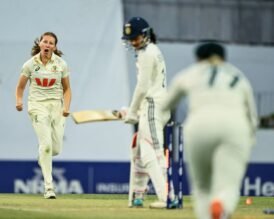

Scheduled as a four day match, this one was all done and dusted not long after play recommenced on Day 3, India adding just 44 runs to their overnight position of 156 for 6 before the Aussie openers passed the 25 runs needed for victory in under 5 overs.
Whilst the historic WACA ground has recently been revamped, with addition of various community facilities, as far as the pitch goes it was a case of plus ça change, plus c’est la même chose. The fundamental issue of it being difficult to bat on, unless you happen to get well set, being left untouched. In response to India’s modest first innings showing of 198 runs, the fourth wicket stand for Australia of 128 by Ellyse Perry and Annabel Sutherland illustrating this feature; of the others in the side, only tail-enders Alana King and Lucie Hamilton managed to get into the twenties.
The 24 year old Annabel Sutherland is, by the way, threatening to go on a sustained Bradmanesque spree – in the last three matches having made successive scores of 210, 163 and 129 (striking at 82.0, 63.2 and 75.4 per 100 deliveries), these centuries coming against South Africa, England and now India (and dismissed only twice for less than 15 in her 10 Test innings, those being her initial outings when in the lower order).
For India, in their first innings the former prodigy Jemimah Rodrigues (now age 25) made a defiant fifty (her knock ending on 52) while only two others got into the thirties: the opener, Shafali Verma who has rarely failed to get a start in her 12 Test innings so far (averaging 55.2 with one not out of 24), plus Kashvee Gautam well down the order who remained undefeated.
Whilst the second time around only two of India’s batswomen got beyond 14 – Pratika Rawal at number 3 with a generally grinding innings of 63 (being the last to be dismissed) and Sneh Rana with 30 at number eight. (I can’t abide the term “batter”: for one thing it’s redolent of fish and chips, for another it smacks of giving bowlers a continual battering…perhaps to their eventual death!)
The right and left arm speedster pairing of Darcie Brown and youngster Lucie Hamilton made good use of this pitch and pink ball, and combined well with Sutherland at a little below fast medium, to dispose of India’s specialist batswomen in both innings.
At the WACA ground, partnerships are even more vital to success than elsewhere, and India could manage no better than one of 43 in their first innings, this for the sixth wicket, and 50 for the seventh wicket the second innings. As alluded to above, Australia’s century stand was, in effect, a match winner given the nature of the pitch.
Shades of the Australia vs England men’s Test at this ground in the recent Ashes series when the match finished inside 2 full days, with only three overs of spin delivered in total. The pitch used for this particular match being variously described as having “a healthy dusting of grass”, “a thick covering of grass” and being “spicy” – strongly assisting bounce for both pace and spin. The difficulties for batting being exacerbated by use of the pink ball to fit a day-night format, although this proved counter-productive for attracting spectators to the ground with the match not extending far into Day 3. A crowd of 3,440 turned up for Day 1 and 3,680 for Day 2, which is no more than around one-third of the ground’s capacity (without installing temporary seating). Two thousand and three hundred ventured forth for the truncated Day 3.
One expects the ICC match referee (an Aussie by name of Kent Andrew Hannam) to pass this pitch as “satisfactory”, at least. This is despite the live commentary on the dismissals which is embedded in the ESPN scorecard containing, quite frequently, such phrases as “She does not – sometimes it is cannot – get on top of the bounce”, “shortish and this rears up”, “due to the extra lift on the surface”, “the ball shapes in late”, “with some additional late shape” and “fizzing…it pitches, grips and kicks up”. It may be thought fair game to play a Test match at the WACA’s inherently tricky surface when it forms part of a five or even a three match series, but as a one-off match and with conditions strongly favouring the home side it smacks of gamesmanship, if not of being downright unfair.
It is noteworthy that Australia’s men’s team has consistently favoured selecting pace bowlers at the WACA at the expense of spin (at least during the past three decades), Shane Warne and Stuart MacGill being the notable exceptions and even they usually had modest returns. The team have played 17 Tests there in the new millennium, the last being in 2017/18 before the so-called “Perth Stadium” became an obligatory choice: winning 10 and losing only 4 (three times to South Africa, and never to England in their five encounters). While the Australian women’s Test team has played only two other Tests at the WACA from 2000 onwards (doing so in February 2024 and back in January 2014).
And bias wasn’t confined to the match itself. The television coverage put on by Fox Cricket treated viewers to distasteful – indeed, shameful – panel sessions during the breaks, with Australians monopolising the “discussion”. In reality, it was hardly discussion in the usual sense of the term; far more like a fervent Aussie supporters club, with Mel Jones well to the fore of the handful who were present (though with the former England Test player, Lauren Winfield-Hill in the wings).
Buoyed-up by Australia’s comprehensive triumph over India in the just completed three ODI match series, the panellists were cooing – ad nauseum – about “her wonderful bowling, having India in all sorts of trouble”, “her marvellous batting, simply over-powering…” and so on, and so on. I began to wonder if they realised there were really two teams competing out on the ground, so faceless had India become in this gloating, enamoured chatter.
A positive note to end on: Ellyse Perry, a Sydneysider (apart from a recent spell living in Melbourne, now having returned home) who made 76 at number 3 in this match, is a model to emulate with bat in hand at the crease. The 26 year old Laura Wolvaardt, a resident from birth of Cape Town, and India’s graceful with power left-hander Smriti Mandhana are also of very high calibre (ditto, the former highly consistent Test run-maker, Charlotte Edwards of England).
Though Perry, in my opinion, is one notch higher than all three of them, as well as being considerably more experienced at Test level than those two contemporaries. Aside from her excellent stats – 24 Test innings, 7 not out, averaging 59.2 with 2 centuries (one being a double) and 5 fifties – Perry is a stoke-maker in the classical mould. Her bat either vertical or horizonal, rarely anything in between, building her innings with a patient if often quite busy start pushing singles. I strongly advise: don’t turn down an opportunity to watch her in action!